

Togakushi Shrine: The Half Everyone Skips
After Togakushi's cedar avenue to Okusha, keep walking: up the road is Togakushi Farm, 135 hectares of pasture. Bus times, soba and a day plan from Nagano.
Updated: October 15, 2026. I rechecked the Togakushi bus, which is now reservation-based, the walking times to Okusha and the Togakushi Farm figures.
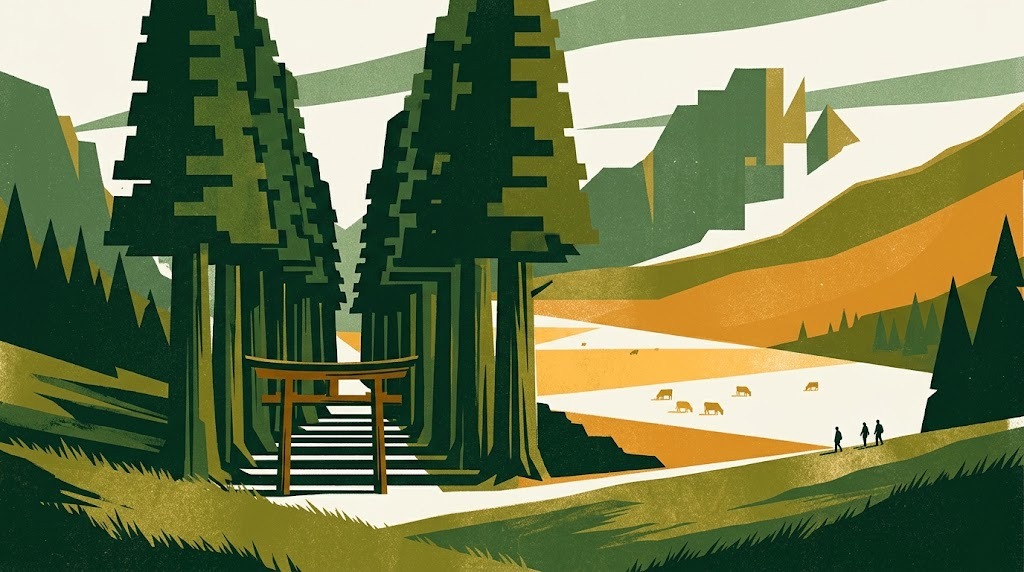
The usual Togakushi day is the cedar avenue to Okusha, a bowl of soba and the bus home. A few minutes’ walk further up the road from the Okusha entrance is Togakushi Farm, 135 hectares of open pasture under the Togakushi ridge, and on a weekday afternoon you may well have long stretches of it to yourself. This is a guide to both halves.
Here’s what happens at Togakushi on a good weekend in August. The bus from Nagano Station pulls in and empties. Everyone walks the same cedar avenue, and it deserves the reputation: trees more than 400 years old, light coming down in columns. Then the last stretch of stone steps up to Okusha, the inner shrine, which is steeper than the photos suggest. Then everyone walks back down the same path, eats soba and waits for the bus. I’ve done that version. It’s fine. But the last time I came, I walked in the other direction from the shrine entrance instead, up the road past the campground, and found open pasture with maybe a dozen people in it.
The part everyone does: the cedar avenue and Okusha
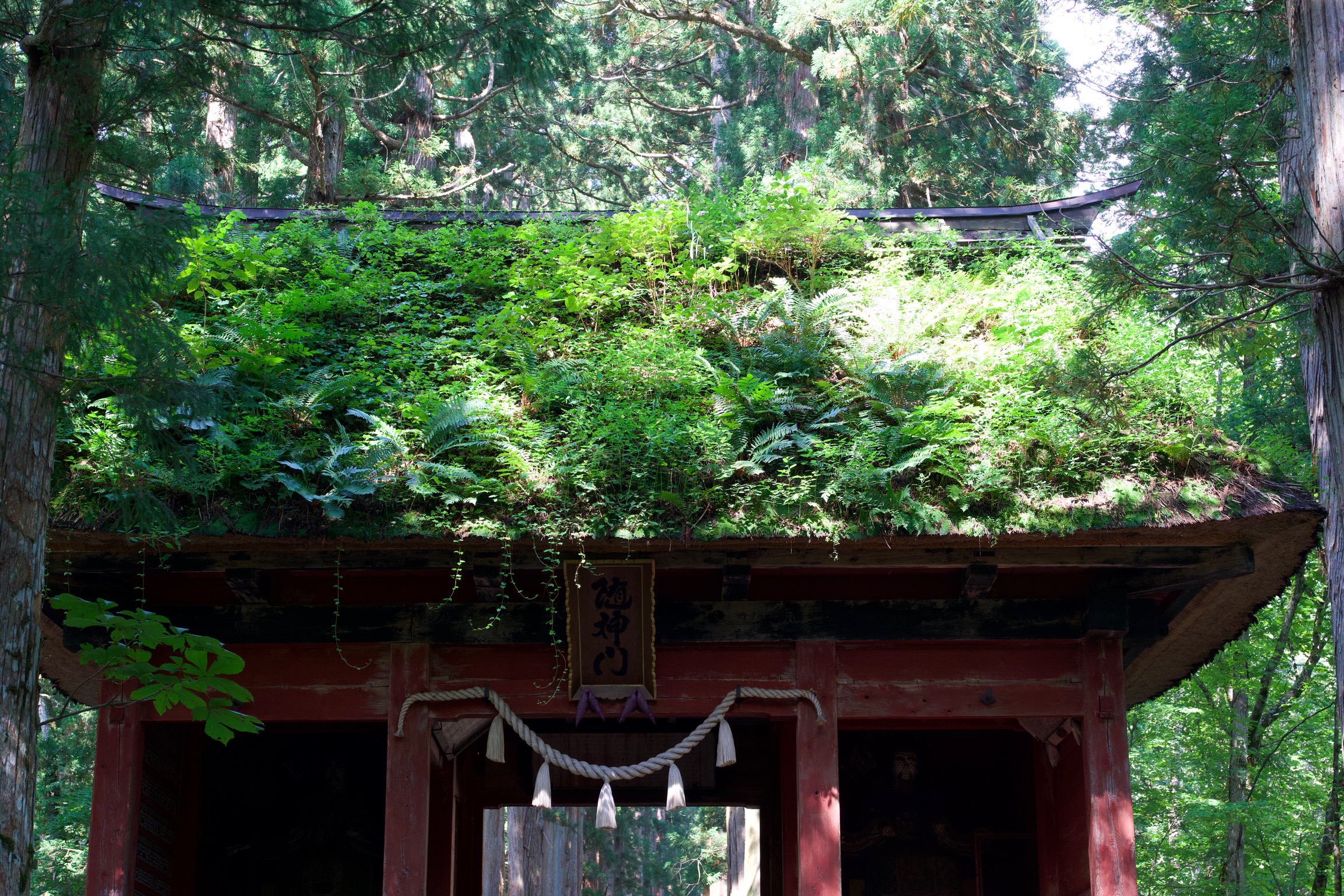
The walk from the Okusha entrance to the inner shrine takes about 35–40 minutes each way, and the last part is steep, uneven stone steps. Togakushi Shrine puts it at about 15 minutes on an almost flat path to the red, thatched Zuishinmon gate, then 20–25 minutes beyond it, where the slope turns steep. The whole approach is about 2 km.
I want to be honest here, because this article is about what’s not crowded and it would be strange to pretend the main attraction is a secret. Togakushi Shrine is not a hidden gem. On a summer weekend you will be sharing the cedar avenue with a lot of people. It’s still worth doing.
The cedar avenue starts at Zuishinmon and runs for about 500 metres to Okusha. The trees are kumasugi cedars more than 400 years old, and the avenue is a Nagano Prefecture historic site and natural monument.
Wear proper shoes. This is the single most common mistake I see. People arrive from a city trip in flat-soled sneakers or sandals and struggle on the last section.
Go early if you’re driving. The shrine lists about 200 parking spaces spread across several lots near the Okusha entrance. Once they fill, cars queue on a mountain road with nowhere to turn around. I’d aim to be there before 9:00.
Okusha no Chaya
At the entrance to the Okusha approach, before the walk begins, there’s a soba restaurant that most people walk straight past on their way to the trailhead. It’s worth stopping, and not only for the food.
The building is a 2003 project by Kengo Kuma and Associates, and the shrine runs the restaurant itself. The exterior pairs sliding timber louvres with brown polycarbonate panels, which control light and sightlines depending on how they’re set; inside, the forest is right in front of you while you eat. If you know Kuma’s later work, this is an early version of the same thinking about wood and light. The interior leans traditional, closer to an old farmhouse than to anything you’d expect from the architect’s name on the door, and calmer for it.
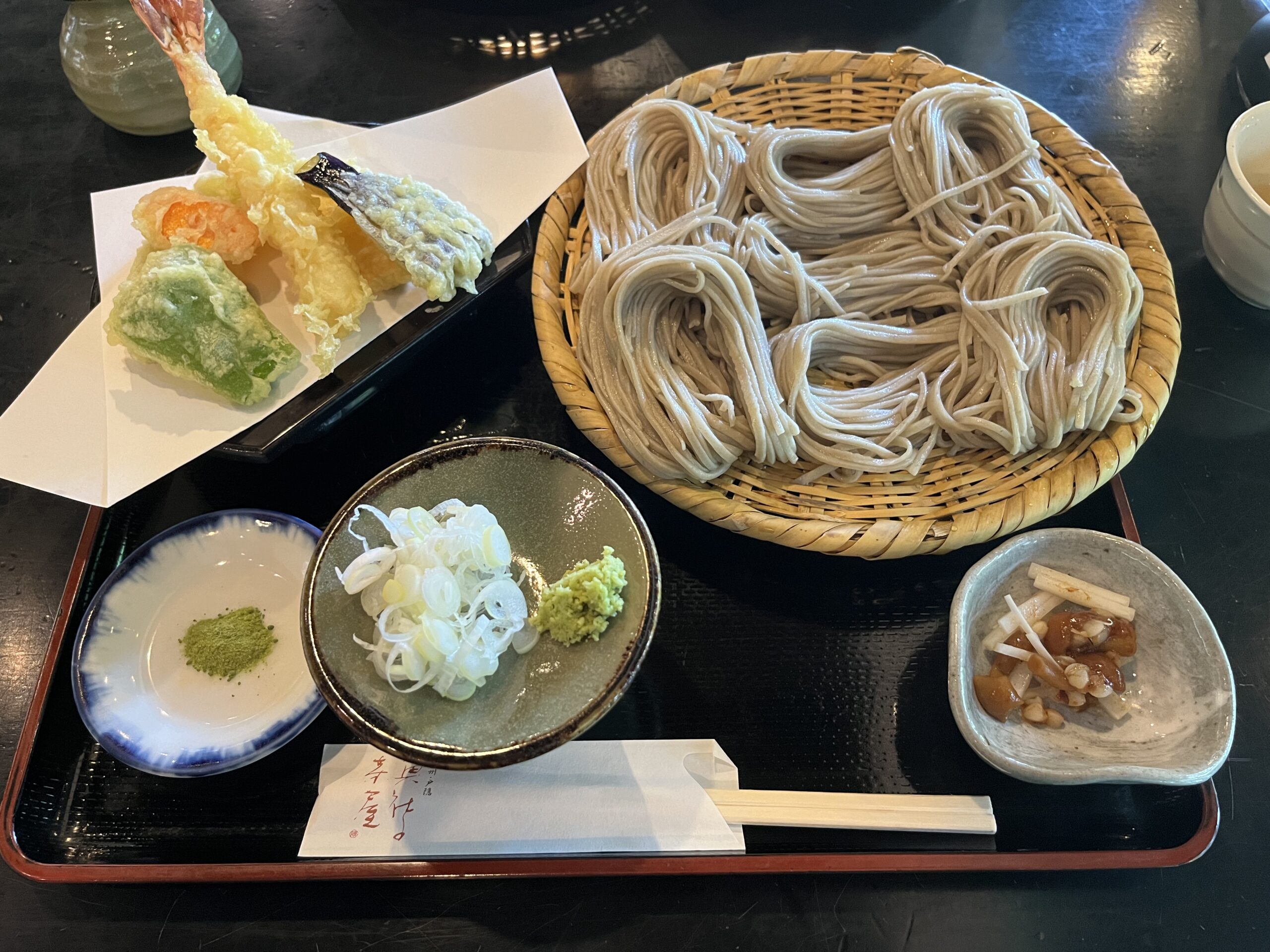
What I had: ten-zaru soba, large portion. The soba has real buckwheat character and, the part I’d come back for, a proper firmness to the bite, which is not a given at a restaurant this busy. The tempura comes with wasabi salt rather than dipping sauce, and it arrives straight from the fryer, so you get it while it’s still audibly crisp. Order the large. The walk is uphill.
Two practical things:
- The soft serve is meant to be eaten outside. There’s seating out front, and on a warm afternoon that’s where the crowd is. The buckwheat flavour is the reason to come.
- The soba can sell out before closing. This is a working soba restaurant on the busiest approach in Togakushi, and on a crowded day they run out in the afternoon. If soba here is part of your plan, don’t leave it until after your walk.
The other half: Togakushi Farm
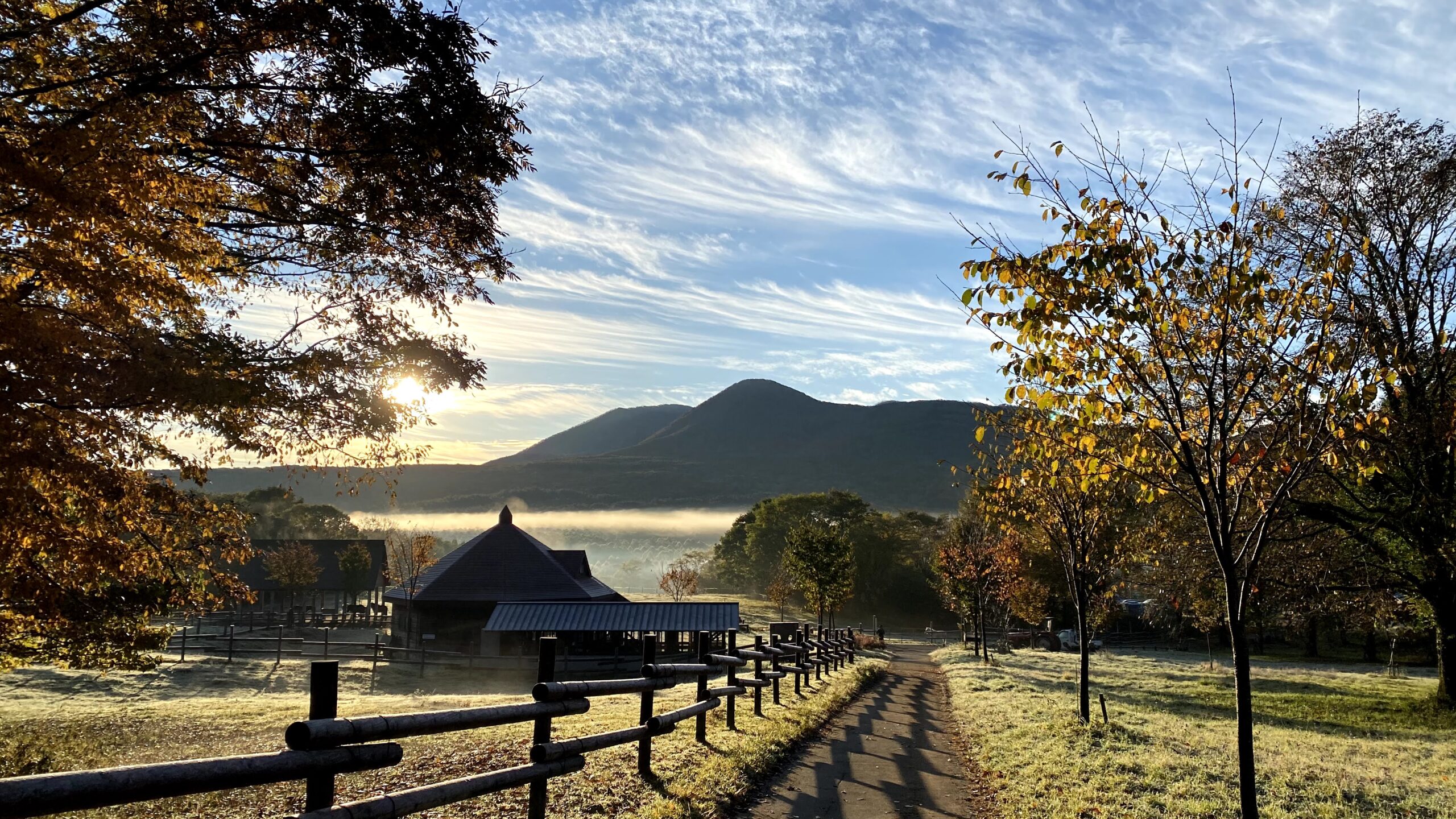
Togakushi Farm (戸隠牧場) is a city-owned grazing farm of 135 hectares, a short walk up the road from the Okusha entrance, past the campground. From the Okusha entrance I walk about five to seven minutes to reach the farm gate.
Some numbers, because they surprise people. Nagano City lists the grazing area as 135 hectares and counted about 11,100 farm visitors in the year to March 2026. The farm opened in 1909, according to the Nagano City Archives, and it sits beside Togakushi Campground at about 1,200 metres, per Go Nagano.
What’s there: cattle and horses grazing across the pasture, a petting area with small animals such as rabbits and sheep, horse rides for primary-school children with an instructor leading the horse, and a soft serve that is, I’m going to be plain about this, the reason I keep going back. In summer, bring insect repellent: the city’s own review of the farm records visitor complaints about horseflies, and about seeing too few cattle.
But the actual point of the place is the space. After the cedar corridor with a queue of people in front of you, walking out into open grassland with the whole ridge visible is a real physical relief. It’s the part of the day I remember.
Soba: eat first, walk second
Eat your soba before the Okusha walk, not after. On crowded days I’ve seen soba here run out in the afternoon, and once it’s gone, it’s gone, however many people are outside.
The day has an awkward shape. If you walk to Okusha first, you come back down to the soba shops at peak lunchtime, into a queue. If you eat first, you’re eating a full soba lunch before an uphill walk. My honest recommendation: eat first, walk second. Soba is light. You’ll be fine.
Where I go
Sobanomi (そばの実) and Naosuke (なおすけ) are the two I return to. I ordered the same thing at both, ten-zaru soba in a large portion, specifically so I could compare them honestly.
Naosuke’s soba has a fresh, almost dewy quality to it, and it goes down remarkably smooth: the kind of texture that makes you understand why people talk about soba in terms of how it feels rather than just how it tastes.
Sobanomi’s soba is the one I’d point you toward first. The flavour is exceptional, with more pronounced buckwheat character than almost anywhere else I’ve eaten in the area. It sits back down the road toward Chusha, beside the turn-off to Kagami-ike pond, rather than at the Okusha entrance, but it’s worth the detour on its own merits.
If you can only do one, go to Sobanomi. If you’re staying in the area for a couple of days, do both; they’re different enough that neither makes the other redundant.
Bocchi-mori: why your soba arrives in coils
Togakushi soba is usually served as bocchi-mori (ぼっち盛り): five small looped portions on a hand-made bamboo tray rather than one pile. The Japan Tourism Agency describes the style as unique to Togakushi, and notes one theory that the five portions stand for Togakushi’s five shrines. It’s worth knowing so you’re not confused when it arrives.
Getting there: the bus is now reservation-based
There is no train to Togakushi; from Nagano Station, the bus takes about an hour, and the main sightseeing service has been reservation-based since April 2025.
By bus. Alpico Kotsu runs the Sightseeing Limited Express Togakushi Line from stop 7 at Nagano Station to Togakushi Campground, stopping at the Okusha entrance on the way. The timetable for 1 April to 4 December 2026 (planned) has 11 departures each way:
| First | Last | |
|---|---|---|
| Nagano Station → Togakushi | 6:50 | 14:10 |
| Okusha entrance → Nagano | 8:19 | 16:24 |
The Nagano Convention and Visitors Bureau explains the booking rules in English: reservations open one month ahead, online only, and close 20 minutes before departure from the first stop; if seats are left, you can board without one, and tickets are also sold at the Alpico counter at Nagano Station. The ordinary route buses to Togakushi still run, but with fewer services, and the bureau asks tourists to leave seats for commuters and students.
Inside Togakushi, the sightseeing express only drops off on the way up and only picks up on the way back, so it won’t carry you from one Togakushi stop to another; Alpico points visitors to a separate local sightseeing shuttle for that. Since 1 August 2026, buses back into Nagano Station set down at stop 9; departures still leave from stop 7.
Watch out
The last bus back is the thing to plan around. The last sightseeing express leaves the Okusha entrance at 16:24, and there is no train to fall back on.
If you carry bear spray, Alpico won’t let it into the cabin: check the safety pin, seal it in a plastic bag and pack it inside a bag that goes in the luggage hold.
By car. Faster and more flexible, but parking at Okusha is the constraint, not the driving. In autumn 2026, the Togakushi Tourism Association has made the road around Kagami-ike pond one-way from 10 October to 3 November, 9:30–16:00: you can’t drive in from the Chusha and Okusha side, only from the Hokosha side. If you’re driving to Okusha, stay on Route 36 rather than cutting through by Kagami-ike.
By taxi. Togakushi Shrine points visitors to the taxis at Nagano Station. If you’ll need a return ride, agree on a pickup time with the driver before they drop you off.
If you’re still choosing how to reach Nagano from Tokyo, I worked out whether a rail pass pays off for a Nagano trip (for Nagano alone, price the two shinkansen tickets first), and compared cheaper ways to cross Japan than the shinkansen.
Two things about the mountain itself
Bears live in the forests around Okusha, so stay on the marked path and carry a bell. Nagano Prefecture says Asiatic black bears are seen throughout the Togakushi Forest Botanical Garden, one bus stop before the Okusha entrance, and that sightings rise in July and August, when the skunk cabbage fruit they eat ripens. The garden’s visitor centre, Hachijuni Mori no Manabiya, lends bear bells. Never approach a bear, especially a cub, and don’t stop to photograph one. This is not a reason to stay away, but it is a reason not to walk the approach alone at dawn or dusk.
Weather at altitude. The farm and campground sit at about 1,200 metres, so pack a layer even when Nagano city feels warm. In summer the height is the whole appeal. In late autumn it means a layer you weren’t planning to bring.
The day I’d actually recommend
Take the 9:50 sightseeing express, eat first, walk to Okusha, then finish at the farm and catch the bus back from the campground. Here’s how I’d shape it:
- 9:50 — Bus from Nagano Station.It reaches the Okusha entrance at 10:49.
- About 11:00 — Soba first.Okusha no Chaya is right at the Okusha entrance. Sobanomi is back down the road toward Chusha, beside the turn-off to Kagami-ike pond, so if you choose it, give yourself extra time for the walk back up before the shrine. The sightseeing express won’t take you between stops inside Togakushi.
- About 12:00 — Walk to Okusha.About 35–40 minutes up, time at the shrine, the same back.
- About 14:00 — The farm.Soft serve. Sit down. Look at the mountain.
- 15:40 or 16:20 — Bus back from Togakushi Campground,next to the farm. It’s the first stop on the way back to Nagano Station.
The difference between this and the standard version is a short walk in the direction nobody goes.
The cedar avenue is the reason people come to Togakushi, and it should be. But the thing I actually think about afterwards is standing in an empty field with a soft serve, looking up at a ridgeline that most of the people I passed on the path that day never turned around to see.
Quick answers
- Should I leave a tip at a soba shop in Togakushi?
- No. Pay the bill and go; money left on the table reads as something you forgot, not a thank-you. I explain why in my piece on tipping in Japan.
- Can I pay for the Togakushi sightseeing express with Suica or another IC card?
- No. IC cards, commuter passes included, aren’t accepted on this bus. Visa contactless (touch) payment is, or book and pay online in advance.
- Can I take the bus to Okusha in winter?
- Not to the Okusha entrance. Togakushi Shrine says buses don’t go there in winter because the route changes to Togakushi Ski Resort; walk from Chusha or take a taxi, and the Okusha car parks may be unusable because of snow. The sightseeing express timetable runs to 4 December 2026 (planned).
- Should I fit Zenko-ji and Togakushi into the same afternoon?
- Don’t. With an hour on the bus each way, the shrine walk, soba and the farm, Togakushi fills a day from Nagano. People who squeeze in Zenko-ji end up rushing both.
Bus times, walking times and the farm figures checked on 15 October 2026.
— ko, writing from Niigata
Have a Question?