

Why Japanese Waiters Chase You Down the Street — And Why You Shouldn’t Tip in Japan
No, you don’t tip in Japan — but “why not” is the part nobody explains. A Japanese-born editor breaks down what staff are actually thinking, and the few exceptions that are quietly changing.
The moment you realize something is different
You finish a good meal in Tokyo. You leave a few hundred yen on the table, the way you would at home. You walk out.
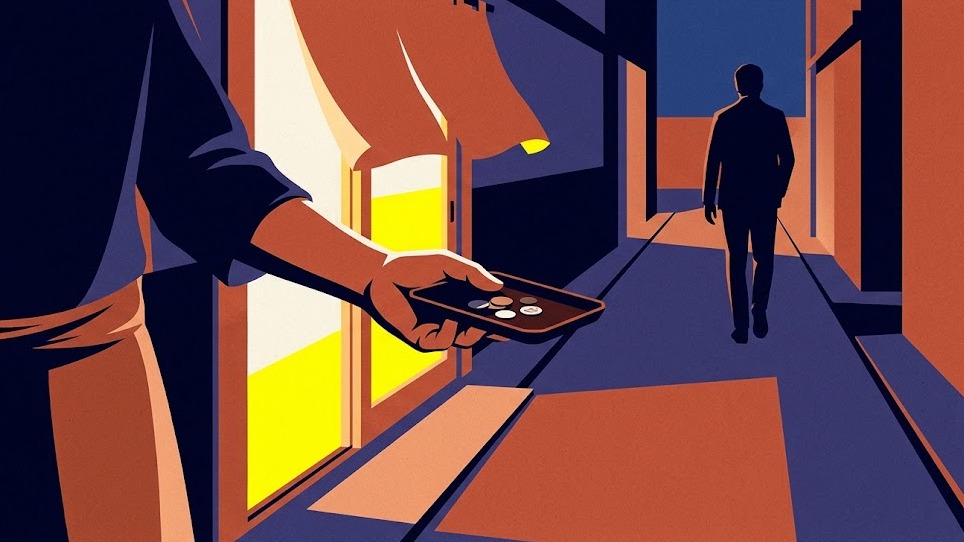
Thirty seconds later, someone is jogging down the sidewalk after you, holding your coins out with both hands and apologizing.
Almost every Japan guide will tell you not to tip here. Very few explain what is actually going on inside that server’s head — which is a shame, because that is the interesting part, and it tells you more about Japan than the rule itself does.
So: no, you don’t need to tip in Japan. But here is why your money keeps coming back to you, what it feels like from the Japanese side of the counter, and the small number of situations where the rule is quietly bending.
Why it reads as “forgotten,” not “for you”
Here is the thing foreign visitors rarely hear: the server chasing you is not making a judgment about tipping. They usually aren’t thinking about tipping at all.
Money left on a table in Japan simply does not register as payment. Payment happens at the register, or in a small tray, or on a bill you carry to the counter — it is a defined, bounded moment with a clear beginning and end. Once that moment is over, the transaction is closed. Cash sitting on the table afterward isn’t a gesture. It’s an object that belongs to you and got left behind, in the same category as a forgotten umbrella or a phone on the seat.
That is why the reaction is so fast and so reflexive. Nobody is deliberating. They are returning your property.
There is a second layer underneath it. In Japan, the price on the menu is understood as the complete and final answer to “what does this cost.” Not a base rate. Not a starting number that gets adjusted upward depending on how the service went. The number is the number, and good service is already inside it — not a bonus feature you unlock by paying more.
This is often explained with the word omotenashi, and that’s not wrong, but it’s a bit abstract for something this practical. I’ve written separately about what omotenashi actually means — the short version is that hospitality here is treated as a baseline standard, not a performance to be rewarded.
What it feels like from the other side
I didn’t understand how deeply this ran until I ate at a restaurant in the United States for the first time.
I knew about tipping before I went. I knew roughly what percentage was normal, and I still think it’s a genuinely good custom — a built-in moment where you get to tell someone directly that they looked after you well. I had no objection to the idea of it.
Then it was time to pay, and the server asked me what I’d like to do about the tip. It was left to me. I was the one choosing the number.
And I had no answer.
Not because I didn’t want to pay it. Because I suddenly had to convert another person’s work into a figure, with that person waiting right there for me to decide. Whatever I chose was going to say something about them. I picked something, nobody blinked, the evening was perfectly pleasant — and I still walked out with something unresolved sitting in my chest that I couldn’t name for a long time afterward.
It took me a while to work out what it was, precisely because at home I had never once had to think about it.
The discomfort isn’t about the money. It’s about the relationship the money creates.
When you tip, you are — however kindly you mean it — grading someone. You are placing yourself in the position of the person who evaluates, and them in the position of the person who is evaluated. In Japanese service culture, the server and the customer are meant to be in a clean, mutual, complete exchange. Nobody is being assessed. Nobody’s income depends on how charming they managed to be at your table.
So when you hand a Japanese server extra money for doing their job well, you are unintentionally introducing a small power imbalance into an interaction that was already balanced. Most of them can’t articulate why it feels off, either — they’ve never had to. It just does.
This is also why “but I want to show appreciation” doesn’t quite land as an argument. The appreciation isn’t the problem. The mechanism is.
Where the rule actually holds — and where it’s bending
“Never tip in Japan” is close enough to true for most trips, but it’s not the whole picture in 2026. Here’s the honest breakdown.
Essentially always no
Don’t tip
- Restaurants, cafés, izakaya, ramen shops. Including expensive ones. If there’s a service charge, it’s already printed on the bill and that’s the end of it.
- Convenience stores, shops, supermarkets.
- Station staff, train and bus crews, drivers.
- Hotel front desk, bellhops, housekeeping. Leaving cash in the room creates a genuine problem for staff, who now have to report and process it as a lost item.
In all of these, attempting to tip doesn’t offend anyone — it just creates work and mild confusion. If you’re unsure where a situation falls, this is the default to assume.
The traditional exception: kokorozuke at a ryokan
This is the one real, long-standing exception, and it’s older than tourism.
A token of appreciation:心づけ(kokorozuke)
At a traditional ryokan, the nakai-san (your room attendant) may serve you personally through the whole stay. A small gratuity called kokorozuke is sometimes given — historically at the start of the stay rather than the end, closer to “thank you in advance for looking after us” than “you did well.”
Two things worth knowing:
- It is genuinely optional, and increasingly rare. Plenty of Japanese people have stayed at ryokan their entire lives and never once done this. You are not committing a faux pas by skipping it.
- If you do it, the form matters more than the amount. Cash goes in a small envelope — never handed over bare — and is offered quietly with both hands. Bare bills passed directly across is the part that would actually feel awkward.
The genuinely gray zone
This is where most guides stop being useful, because the situation has moved.
The exceptions
- Private guides and interpreters. Guides who work regularly with international visitors are often used to being tipped, and many will accept it. It still isn’t expected (JNTO’s guide to tipping says the same, and that a tip goes in an envelope), and guides in Japan are generally paid properly rather than tip-dependent. If you want to, an envelope at the end of the day is fine. If you don’t, nothing is wrong.
- Taxis. Historically a firm no, and still a no in the overwhelming majority of cases. Some apps have added optional digital tips — Uber added one for its taxi service in Japan in November 2021 — but it hasn’t become a norm and you should not assume it’s available or wanted.
- Businesses that have added tip lines for foreign customers. A small number of places in heavily touristed areas have started accommodating tipping because visitors kept trying. This is a response to demand from outside, not a shift in local custom — and it’s fairly contested among Japanese people, who mostly hope it doesn’t spread.
The organized attempt to introduce American-style tipping to Japan as a business, the “Tip Project,” sold “tip tickets” to restaurants in 2021 and listed just over ten restaurants using them. Its website no longer shows a working service, which tells you roughly how much appetite there was for it.
The working rule: if you have to wonder whether tipping is appropriate here, the answer is no.
What to give instead
The good news is that the things that actually land are free.
Say it out loud. Japanese service interactions are quiet by default, so a direct verbal thank-you carries more weight than visitors expect.
What to say instead
- “Arigatou gozaimasu” — the universal one. Works at the hotel desk, the shop counter, when someone holds a door.
- “Gochisousama deshita” — specifically for after a meal, said as you leave a restaurant or finish dinner at your ryokan. It’s addressed to the people who made the food, not just the server. This one reliably gets you a real smile.
Leave a review. For a small independent restaurant or a family-run inn, a specific, positive Google Maps review in English is worth considerably more than a few hundred yen. It reaches people the owner could never reach on their own. If you want to give something with actual value, this is it.
Be an easy customer. Returning your tray, stacking your dishes slightly, keeping your voice down, not lingering at a table during a queue — these register as respect in a way that money doesn’t.
The short version
Not tipping in Japan isn’t withholding something. The exchange was already complete when you paid the bill.
Keep your coins, say gochisousama deshita on your way out, and leave a review when you get back to your hotel. That’s the version of appreciation that actually arrives.
Tipping customs and the examples above checked on 17 October 2026.
— ko, writing from Niigata
Have a Question?