

Asakusa Tori-no-Ichi 2026: What the Rakes and Clapping Mean
Tori-no-Ichi at Otori Shrine in Asakusa runs 00:00–24:00 on 7 and 19 November 2026. Why people buy kumade rakes, haggle, then clap when the deal is done.
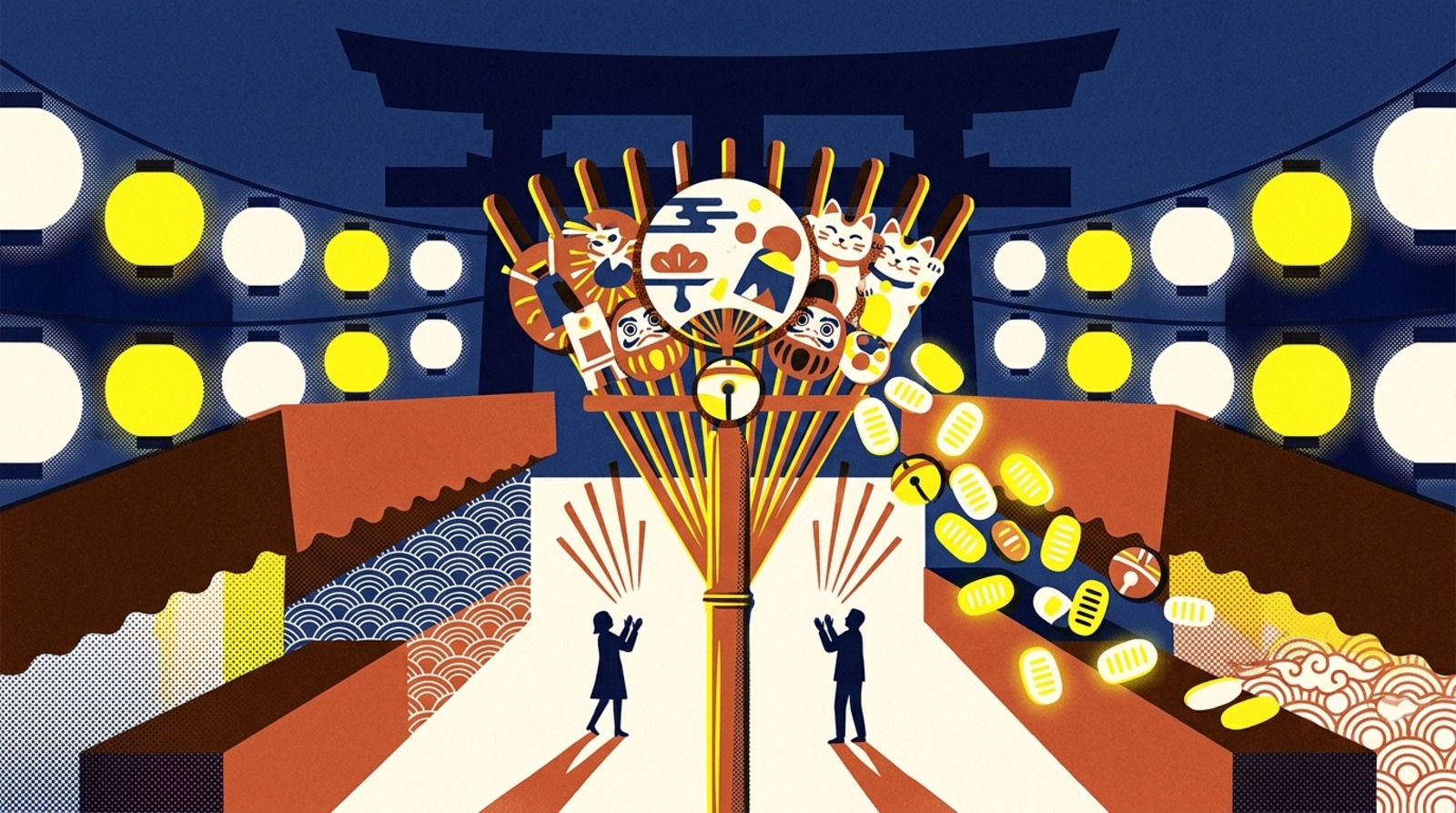
Tori-no-Ichi at Otori Shrine in Asakusa falls on Saturday 7 November and Thursday 19 November 2026, and each day runs for a full 24 hours from midnight. People come to buy a kumade, a decorated bamboo rake meant to “rake in” luck for the coming year. When a price is agreed, the stall and the buyer clap together. The shrine calls this tejime and says it marks the deal as done.
This guide covers the parts a Japanese visitor already knows and rarely says out loud: why bargaining is allowed here, why some buyers hand the discount straight back, and what to do with the rake once it is home. Otori Shrine explains the last two on its own pages and the Japan Tourism Agency explains the first, so everything here comes from those two sources. I have not bought a kumade for this article myself.
7 and 19 November 2026: two days, each 24 hours
There are two Tori-no-Ichi days at Otori Shrine in 2026: the first rooster day on Saturday 7 November and the second on Thursday 19 November.
Otori Shrine’s page for this year’s market lists both and says each runs from 00:00 to 24:00, starting with the first drum at midnight.
The dates move every year because they follow the rooster days of the Chinese zodiac; in 2026 the second falls 12 days after the first. The shrine explains that when November has two rooster days the market runs to the second, and when it has three, to the third. 2026 has two.
- Where: Otori Shrine is in Senzoku 3-chome, Taito City.
- Nearest station: The shrine’s access page gives about 7 minutes on foot from North Exit 3 of Iriya Station on the Hibiya Line, and about 8 minutes from Asakusa Station on the Tsukuba Express.
- Driving: The shrine has no parking on market days and asks visitors to use public transport.
- Crowds: The shrine puts attendance at 700,000–800,000 people a year, with about 150 rake stalls and about 750 other stalls.
The shrine also holds two formal rites each market. The eve rite starts at 23:15 on Friday 6 November and Wednesday 18 November, and a special rite starts at 13:00 on 7 and 19 November. Visitors can attend, but the shrine says advance booking is required and asks you to check in 15 minutes before.
Why a rake: the shrine’s story
The rake comes from the shrine’s own founding story.
According to Otori Shrine’s history page, the legendary prince Yamato Takeru stopped to pray here for victory, and on his way back he hung a kumade — a rake used as a war tool — on the pine tree in front of the shrine to celebrate. That day was a rooster day in November, and it became the shrine’s festival day.
Today the rake is read as a tool for gathering in luck. The Japan Tourism Agency describes the kumade as an ornate bamboo rake believed to help people “rake in” prosperity for the coming year or ward off bad luck. It also says the tradition is said to have begun at Chokokuji Temple and Otori Shrine in Asakusa.
There are two kinds of rake at the market, sold by different people:
- Kakkome: the shrine’s own small kumade charm. The shrine gives it out only during Tori-no-Ichi, starting with the first drum at midnight. The shrine’s history page says the very first person to receive a kakkome when the drum sounds is given the shrine’s gold koban coin as the “first ticket”; this year’s market page does not mention it, so do not plan your night around it.
- Engi kumade: the decorated rakes sold by the stalls. The shrine says these are sold at about 150 stalls, mostly inside the grounds.
The shrine says the usual order is to pray first, receive the kakkome, and then buy a decorated kumade.
Start small: what the size and price mean
A kumade is not a one-off souvenir in the Japanese way of thinking.
Otori Shrine says the custom is to start with a small one and move up in size as the business or household prospers.
The shrine says prices run from about ¥1,000 for small rakes to hundreds of thousands of yen for big ones, and, with a hedge of its own, that the best sellers seem to be around ¥20,000–50,000. Two rakes of the same size can cost different amounts, because the price depends on how many ornaments are attached and which ones. The shrine’s advice is to walk once around the whole grounds before choosing.
The kumade is no longer only for shop owners. The shrine notes that people now buy them for family safety, health, winning, and love, not just business.
Haggling, then handing the discount back
Bargaining is expected at the kumade stalls, which is unusual in Japan.
The Japan Tourism Agency calls it “a departure from normal custom” and says buyer and seller are expected to settle on a price both accept. It adds that the stall is expected to keep the change.
Otori Shrine goes one step further. It says how much you can knock off is up to your skill, but that in the old days the stylish way to buy was to leave the amount you had bargained off at the stall as goshugi, a celebratory gift. In practice, the buyer ends up paying the stall’s first price. The shrine explains why people did it anyway: the buyer got to feel generous, and the stall got to feel it had earned extra.
So the haggling is part of the show, not only a way to save money. It is the opposite of the everyday rule: as I explain in my guide to why you shouldn’t tip in Japan, money left on a table normally comes back to you.
The clapping means the deal is closed
When the price is settled, the stall claps with you.
Otori Shrine calls this tejime (also tejimai) and says it signifies that the deal has been concluded; it is done while praying for the buyer’s home or company to prosper.
The Japan Tourism Agency describes buyers being sent off with rhythmic clapping, and sometimes a cup of sake, to show appreciation. Neither source describes a set clapping pattern; the stall leads it.
If you are buying, the order in the shrine’s description is:
- Look first.Walk the grounds and compare ornaments before you stop at a stall.
- Agree a price.Bargaining is expected; the shrine leaves the amount up to you.
- Decide on the change.The Japan Tourism Agency says stalls are expected to keep the change, and the shrine says the old stylish way was to leave the whole bargained amount as goshugi.
- Clap.The tejime closes the deal.
After the market: 28 December, and back next year
A kumade is meant to be put up at home and returned after a year.
Otori Shrine’s guide to keeping charms says new charms and kumade are put up on a household shrine shelf or similar place on 28 December, at the end of the year. In 2026 that is a Monday, the last weekday before government offices stop for Japan’s New Year closures. If you are replacing an old one, you can put the new one up straight away.
- Where: as high as possible, ideally with its back to the north so it faces south or east. If there is no such spot, the shrine says simply avoid having it face north.
- The old one: after a year, take it back to the shrine or temple where you bought it, with a small fee for ritual burning.
The Japan Tourism Agency also encourages visitors to come back in later years, return their kumade and give thanks before buying a new one.
This is the part that fits short-stay visitors least. The shrine’s guidance is written for people who can put the rake up by 28 December and bring it back to Senzoku a year later. The Japan Tourism Agency notes that some rakes fit in the palm of a hand while others have to be carried over the shoulder, so pick a size you can get onto a plane.
What I could not settle
Not confirmed yet
- Traffic and crowd control: When I searched on 14 October 2026, I found no 2026 notice from Taito City or the Asakusa Police Station about road closures for the market. Look again in early November.
- Photography: The shrine’s pages do not set out rules for photographing the stalls or the clapping. Ask the stall before filming a purchase.
- Kakkome price: The shrine does not list it online.
Quick answers
- Should I buy a big kumade as a souvenir to take home?
- No — not on a single trip. Otori Shrine asks that kumade and charms alike go back to the shrine or temple where you got them after a year, which is hard to do from abroad. If you want one anyway, a kakkome or one of the smallest stall rakes is at least easy to carry, but the custom still assumes you bring it back.
- Do I have to go on the first day?
- No. Otori Shrine says the market is thought to have begun on the first rooster day and, from the mid-Edo period, to have spread to the second and third, so the blessing is the same whichever day you visit. Pick the date that fits your trip.
- Can I have a prayer said for me inside the main hall?
- Yes. The shrine says prayers in the main hall are held throughout the market in order of arrival, with advance booking also possible. The offering starts at ¥5,000, and one family or group can have up to five people attend.
- Is a year with three rooster days bad luck?
There is no third day in 2026. In years that have one, people say there are more fires. The shrine says the origin of that saying is not really known and lists a few theories, including a warning about fire in the cold, dry season.
Dates, rites and the shrine’s guidance checked on 14 October 2026.
— ko, writing from Niigata


Have a Question?