

What Is Omotenashi? Why Japanese Almost Never Say the Word
Omotenashi is motenashi, looking after a guest, made polite. Why Japanese almost never say it, why staff go rigid, and Tokyo's 1 April 2025 harassment rule.

Updated: October 15, 2026. I added the date Tokyo’s customer harassment ordinance took effect (1 April 2025), the national employer rules in force since 1 October 2026, and the Consumer Affairs Agency’s guidance on allergy information at restaurants.
Omotenashi (おもてなし) is the Japanese word for hospitality: care that anticipates what a guest needs before they ask, offered as a standard rather than in exchange for anything. Some English explanations add that the idea is rooted in the tea ceremony, where the host prepares every detail on the understanding that this particular gathering will never happen again.
That definition is fine. It will help you understand roughly what people mean.
Here’s what those explanations leave out: Japanese people almost never use this word. Not in conversation, not at work, and not about ourselves. That is my read as someone born and raised in Japan, not a statistic, and the history of the word below helps explain why it feels that way to me. That gap is worth understanding, because it changes how you read almost every service interaction you’ll have here.
Where the word actually came from
Omotenashi is the ordinary word motenashi, “looking after a guest”, with the polite prefix o- in front; it became a national slogan only in 2013.
The verb behind it is motenasu. The Daijisen dictionary writes it もて成す, and its first two meanings are to treat a person and to look after a guest with care. The entry for the noun in Heibonsha’s World Encyclopedia says it first meant treating someone with care and later came to mean entertaining a guest with food and drink. Grammatically, that’s all it is: a courteous way of saying “hospitality.”
You may read a different explanation in English: that omote means “public face” and nashi means “without,” so omotenashi is hospitality with nothing hidden behind it. It’s a lovely idea, and you will find it on some hotel and travel pages. The dictionaries don’t support it. They treat the word as motenashi, dressed politely.
What turned it into a national self-description was September 2013. Tokyo was bidding for the 2020 Olympics, and in its presentation to the International Olympic Committee session in Buenos Aires, the newscaster Christel Takigawa spelled the word out syllable by syllable. Tokyo won the vote on 7 September 2013 at the 125th IOC Session, as the International Shooting Sport Federation reported that day. The same year, “o-mo-te-na-shi”, written with the dots between syllables the way she said it, was one of four phrases that shared the grand prize of the New Words and Buzzwords Awards, with Takigawa named as the recipient.
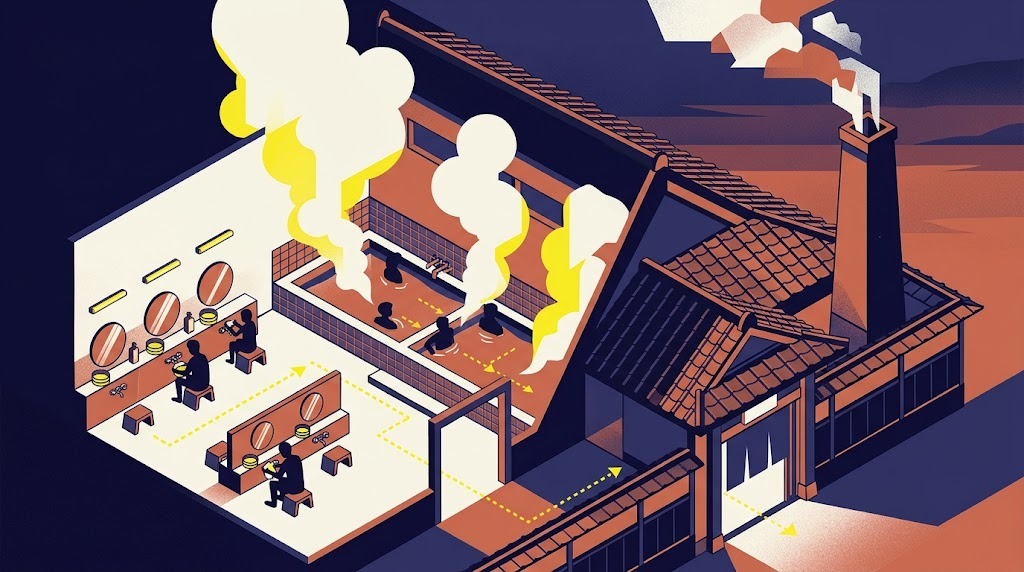
So when you meet this word constantly in English and almost never in everyday Japanese, that’s not a translation gap. It became a word for explaining Japan to people outside it. Inside, it was never needed. You don’t name the water you swim in. It’s the same reason my guide to Japanese public baths opens by admitting that I was never taught the rules.
What you are actually experiencing
What visitors call omotenashi is usually two different things: a trained standard that is the same at every branch, and a rarer, personal kind of attention from someone who can make decisions.
The first is standardisation. The identical greeting at every branch of a convenience-store chain, the set phrases of keigo (formal Japanese), the change placed in your hand with both hands: when the same words come out of every employee at every branch, that is a standard a company teaches, not a feeling each clerk invents on the spot.
That is not a criticism of them or of the system. A society where the baseline of service is set high, consistently, regardless of who happens to be on shift, is pleasant to move through. But it is a system-level achievement, not a series of personal gifts to you.
The second is the real thing, and it’s much rarer. The ryokan attendant who has looked after your room all stay and has tea ready when you come back cold. The chef at a small counter who can see how fast you finished the last course and times the next one. The owner of a small shop who remembers what you bought. This is individual, attentive, labour-intensive and expensive, which is why you find it where one person serves a few guests, not at a chain.
Both are worth appreciating. Conflating them is what leads visitors to misread what’s happening: reading a scripted interaction as personal warmth, or expecting ryokan-grade attentiveness from a 24-hour chain at 3:00. It also explains something I’ve written about elsewhere: why nobody here expects a tip. Good service isn’t an individual performance you’re being invited to reward. It’s the floor.
Why the room goes quiet when you ask for something unusual
Japanese service is superb inside the range it was designed for and can become rigid outside it, because the person in front of you is often not the person who decides.
If your training is built around carrying out a defined standard flawlessly, a request outside it is not a small ad-lib. It is a moment where you no longer know what “doing this correctly” looks like, and where being wrong feels worse than being unhelpful. Improvising isn’t a lesser version of good service in that framework. It’s a risk.
Food is where this matters, and there is a concrete reason. According to the Consumer Affairs Agency, restaurants and takeaway counters in Japan are not required to provide food-allergy information at all. Some publish allergen tables voluntarily. The same leaflet warns that the person who takes your order and the person who cooks are often different people, that staff may change often, and that a server’s “it’s not in it” may not be reliable. It also says cross-contamination in a restaurant kitchen is hard to prevent completely, and that the final call on what you can eat is yours, not the restaurant’s.
Knowing this makes you a much more effective customer:
- Ask early. Raise dietary restrictions when you book or when you sit down, not after the food is being plated.
- Ask about the dish, not the exception. “Does this contain egg?” is a question the staff can check. “Can you make this without egg?” asks them to change the standard.
- Show it in writing. The Consumer Affairs Agency’s English Food Allergy Communication Sheet lets you tick your allergens on a phone screen, with each item labelled in Japanese too; download it before you use it so the boxes work.
- Let them fetch the right person. The agency tells diners with allergies to ask the person in charge or a staff member who knows about allergies. When a server says “please wait a moment” and disappears, that may well be what is happening.
- Hear a no as a rule, not a mood. The person may simply not be allowed to change the dish. Pushing harder is unlikely to turn it into a yes, and it puts them in a worse spot.
None of this is a defect you need to work around resentfully. It’s a different setting on the same dial: the reliability you enjoy everywhere else and the inflexibility you hit here are the same trait, seen from two sides.
Where to actually feel it
If you want the individual version rather than the systemic one, go where the person serving you has the authority to decide.
- A ryokan with one attendant for your room. One person who knows when you went out, when you came back and what you ate is the structural condition that makes anticipation possible.
- A counter restaurant with a handful of seats. The person cooking can see your plate. That’s the whole mechanism.
- A small tea ceremony. The idea is tied to the tea room, and the scale is the point: one host, a few guests, nothing mass-produced.
- Any shop run by the person who owns it. Owners can bend their own rules. Employees may not be allowed to.
The common thread isn’t price. It’s whether the person in front of you is empowered to respond to you rather than to a standard.
The rules that protect the people serving you
Since 1 April 2025, Tokyo’s Customer Harassment Prevention Ordinance has said that no one may engage in customer harassment in any situation; since 1 October 2026, every employer in Japan has had to put measures against it in place.
It is tempting to describe all this as being “treated like royalty.” I’d rather not put it that way. What you’re receiving is skilled work, done by people at their jobs, and Japan has started writing that into its rules.
The ordinance was promulgated on 11 October 2024 and came into force on 1 April 2025, according to the Tokyo Metropolitan Government’s English text of the ordinance, and the metropolitan government explains the rules on its page for foreign nationals. The ordinance defines customer harassment as assault, threats or other illegal acts, or excessive demands without a legitimate reason, abusive language or other unjustified acts, directed at a worker about their work and harming the working environment. It says customers must try to take care with their words and actions towards workers, and it states that, in preventing customer harassment, customers and workers must respect each other on an equal footing.
Nationally, the Ministry of Health, Labour and Welfare says the amended Act on Comprehensive Promotion of Labour Policies, in force from 1 October 2026, requires employers to set a policy of protecting staff from customer harassment and to tell staff in advance how such cases will be handled. One of the ministry’s examples of a response set in advance is that staff ask a supervisor how to handle the situation on the spot. The same guideline is clear that not every complaint is harassment: a complaint made within what is socially acceptable is a legitimate request.
For a visitor, the practical reading is simple: asking, and even complaining, is fine. The line the ministry draws is at demands and behaviour beyond what is socially acceptable.
The most respectful way to receive this kind of care isn’t to enjoy being elevated by it. It’s to notice the work in it. Be on time. Say something as you leave. Don’t make someone break a rule they’ll be answerable for. Handled that way, omotenashi stops being a performance you watch and becomes what it was in the tea room: two people, present, doing a thing well together, once.
Quick answers
- Should you quote “the customer is god” when staff say no?
- No. The saying okyakusama wa kamisama desu comes from the singer Minami Haruo, and Minami Haruo’s official site says that by “customers” he meant his concert audience, that he never meant customers should be indulged whatever they do, and that the phrase is misused when people quote it to back up a complaint.
- Will Tokyo’s ordinance fine a tourist who complains?
- No. The ordinance contains no penalty provisions, and its Article 5 says it must be applied without unreasonably infringing on customers’ rights. It is a statement of rules and responsibilities, not a list of fines.
- Why does a convenience-store sandwich list allergens when a restaurant doesn’t have to?
- Because Japan’s labelling rules cover packaged food. Packaged foods must show nine allergens when present: shrimp, crab, walnut, wheat, buckwheat, egg, milk, peanut and cashew. Cashew was added on 1 April 2026, and Nagoya City notes that products made, processed or imported up to 31 March 2028 may still carry the old label. Twenty more allergens, including almond, soybean, sesame and banana, are only recommended, so a missing label for those does not mean the food is free of them.
Ordinances, guidelines and labelling rules checked on 15 October 2026.
— ko, writing from Niigata

Have a Question?