

Buying a Japanese Kitchen Knife: The Part After the Shop
From 1 November 2026, tax on a knife bought in Japan comes back only after an airport customs check, so do the check before the knife goes in your checked bag.
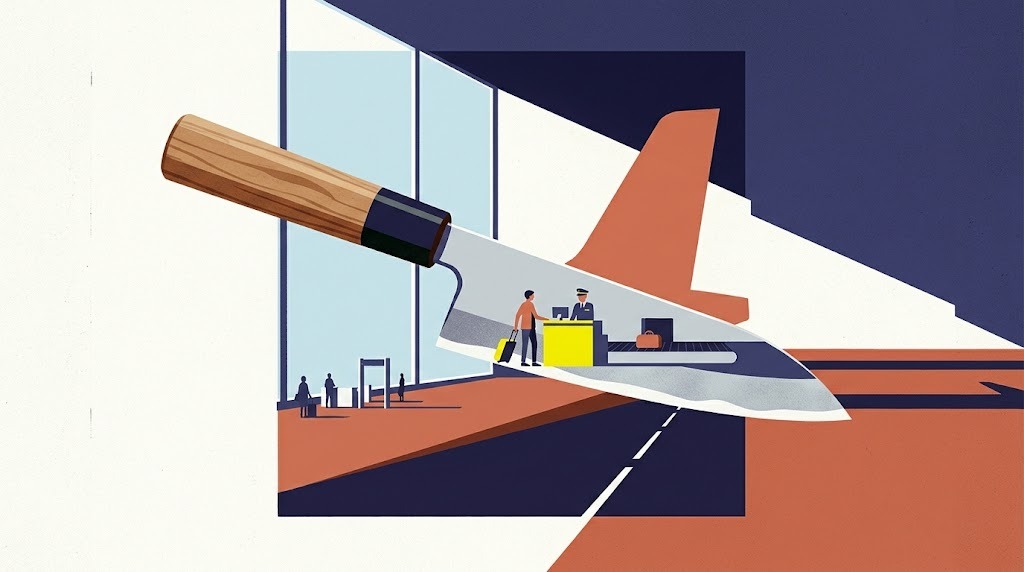
A knife you buy in Japan can be tax-free, but from 1 November 2026 the refund depends on showing it to customs at the airport — and because a knife can only travel in checked luggage, that customs check has to happen before you drop your bag. Get the order wrong and the bag cannot be pulled back; the refund for everything on that receipt is lost.
In my search on 12 October 2026, the English pages I found about Sakai knives were shop guides, shop blogs and forum threads. Some cover parts of what follows, but I found none that puts Japan’s carry law, the new tax-free rules, the airline rules and home customs in the order you actually meet them. That order is this article: shop, hotel, airport, home. I read the statutes and the government pages myself and list at the end what I could not settle.
Sakai’s knives are made by a division of labour: Sakai City describes separate craftspeople for forging, sharpening and handle-fitting, and Sakai uchihamono was designated a national traditional craft on 5 March 1982. The rest of this article is about what happens after one of those knives is wrapped.
1. In the shop: decide tax-free or shipping before you pay
If you buy on or before 31 October 2026, the current system applies, because the Japan Tourism Agency ties the switch to the date of purchase: a tax-free shop sells to you without tax at the counter, and you show your passport to customs when you leave. Everything below is about purchases from 1 November 2026.
Under the system that starts on 1 November 2026, you pay the tax-inclusive price and get the consumption tax back only after customs confirms at departure that you are taking the knife out of Japan. The Japan Tourism Agency’s page for travellers says the refund comes from the shop or a refund company the shop appoints.
Is a Sakai knife tax-free? It can be, on these conditions:
- The shop is a tax-free shop, and you spend ¥5,000 or more (before tax) at that shop on that day. The ¥5,000 minimum is unchanged by the reform. What disappears, according to the agency’s comparison table of the old and new systems, is the old split between “general goods” and “consumables”, the ¥500,000 cap on consumables and the sealed-bag packing for consumables.
- You leave Japan within 90 days of the purchase, counted from the day after you buy; the Japan Tourism Agency’s FAQ for travellers says the customs check must be done at departure within that period.
- You can carry everything on the receipt out yourself. The Japan Tourism Agency’s FAQ for travellers limits tax-free purchases to what you can personally carry and take out of Japan when you leave.
How the refund is paid — bank transfer, card, app or cash at the airport — differs by shop. The Japan Tourism Agency’s FAQ for shops says the government itself collects no fee for refunds. It also says the rules do not decide whether you or the shop pays a refund company’s fee, and notes that in other countries the traveller usually pays it. Ask before you pay.
The alternative is to let the shop ship the knife abroad. The “direct shipping” scheme survives the reform, moved under the general export exemption. If the shop offers it, the shop, acting as agent for an international freight forwarder, signs you up for the shipment at the counter and takes the knife on the spot, and it can sell the knife to you at the price without tax. There is no ¥5,000 minimum and no customs check at the airport for that knife, according to the National Tax Agency’s Q&A on the refund method (July 2026, Q41). If you pay in cash, the same answer says the shop must also keep a document equivalent to your destination country’s import permit to use this scheme; a card payment does not need it. Ask whether your payment method matters.
Mailing the knife home yourself does not count. The Japan Tourism Agency’s FAQ for travellers says the “separate shipment” route, under which travellers posted their own tax-free goods abroad, was abolished on 31 March 2025, and the National Tax Agency says only goods bought on or before 31 March 2025 can still use it, so it is not available for anything bought from 1 April 2025.
Questions worth asking at the counter (my suggestions, not official guidance):
- Are you a tax-free shop, and how will the refund be paid? Is there a fee or a deadline for claiming it?
- Can you use direct shipping to my country, what does it cost, and does it matter if I pay in cash?
- Can you pack the knife for a checked bag — blade covered, boxed — and keep everything on one receipt?
- If I want engraving, how many days does it take?
2. From the shop to your hotel: carrying is a legal question
Japanese law bans carrying a blade longer than 6 cm without work or another legitimate reason, and the penalty is up to two years’ imprisonment or a fine of up to ¥300,000. That is Article 22 of the Firearms and Swords Control Law, with the penalty in Article 31-18. Under Article 101 of the law’s Enforcement Regulation, the blade is measured in a straight line from the tip to the nearest point of the handle; if your knife’s blade is longer than 6 cm measured that way, Article 22 applies to it.
Taking a knife home after buying it is the example Kagoshima Prefectural Police give of a legitimate reason. Shizuoka Prefectural Police define “carrying” as having the blade under your control in a state where you could use it at once.
No police page I found says how long a detour is acceptable, so I take the cautious reading:
- Keep the knife in the shop’s box and wrapping, deep in your bag, not where it can be drawn at once. The box matters for the refund too: the National Tax Agency’s Q&A (Q39) warns that if you separate goods from their packaging or throw away packaging that identifies them, customs may be unable to confirm them.
- Keep the receipt with it.
- Go to your hotel. If you want lunch or sightseeing, buy the knife at the end of the day, or on the day you fly.
3. At the airport: customs check first, then bag drop
Do the customs check at the tax-free kiosk before you check in your suitcase. The Japan Tourism Agency says the check cannot be done once a bag has been checked, and airlines will not hand a checked bag back for the tax-free procedure. The agency says the kiosks and the customs inspection area are in the international departure lobby, before baggage check-in; find them before you join the check-in queue.
The steps:
- Scan your passport.At the kiosk or electronic terminal, show your passport with the knife and everything else on the receipt with you. The agency’s FAQ says the terminal shows its result a few seconds after scanning.
- Green: check in your bag.The procedure ends. Check in your suitcase with the knife inside.
- Red: show the goods first.Take the goods to the customs inspection point and show them to a customs officer. Only then check in the bag.
At seven busy airports — Narita, Haneda, Kansai, Chubu, Fukuoka, New Chitose and Naha — the Japan Tourism Agency’s FAQ for travellers says you can do the same step on your phone through Visit Japan Web instead of the kiosk, inside the departure lobby’s dedicated Wi-Fi area up to the security checkpoint. Kansai International Airport is on that list; Sakai City’s access page puts Mozu Station in Sakai about 35 minutes from it by train, using a rapid train for part of the way and not counting the time to change trains. The order does not change: the knife must still be with you, not in a checked bag.
The check must be finished, inspection included, before boarding procedures. The agency’s page for travellers states that if you miss your flight because of the tax-free procedure, neither the airline nor customs will compensate you. Leave time for a red result: you will be unpacking a box that the shop wrapped.
Watch out
One missing item voids the whole receipt. If you cannot present even one item from a single purchase record, none of the items on that record get the tax back, according to the Japan Tourism Agency. If you buy a knife and a whetstone together and pack the whetstone in a bag you already checked, the knife loses its refund too. One more reason to keep everything from one receipt together until the kiosk.
4. Into the checked bag, never the cabin
On flights from Japan, knives cannot go in the cabin at all — the 6 cm line does not apply on the plane. The Ministry of Land, Infrastructure, Transport and Tourism’s list of restricted items (updated 24 April 2026) marks knives as not allowed as carry-on and allowed in checked baggage; the only cabin exception is a knife with no sharp point that would not work as a weapon, such as a butter knife. ANA’s page for international flights says all blades, knives included, may not be taken on board, and warns that taking one into the cabin breaks the Civil Aeronautics Act, with up to two years’ imprisonment or a fine of up to ¥1,000,000.
What this means in practice:
- A carry-on-only fare and a kitchen knife do not go together. If you travel with a cabin bag only, use shop shipping or pay for a checked bag. Japan’s low-cost carriers also have tight cabin-bag rules, which matters if you were planning to cross Japan by budget flight.
- A 2002 ministry press release says knives can be flown if “suitably packed” and checked in with the airline. It gives no packing standard, and I found none from ANA. Blade guard on, box, wrapping, padding around it is the common-sense version. The US TSA asks for sharp objects in checked bags to be “sheathed or securely wrapped”.
- Airlines may set stricter rules than the ministry. Check your own airline’s page for the flight you booked.
5. At home: your own country’s customs
Rules for bringing a kitchen knife home are set by your own country; none of the three official sources I checked lists an ordinary kitchen knife as banned, but only the US rules say outright that household knives are admitted.
- United States: CBP enforces the knife rules in 19 CFR 12.95–12.97. Under section 12.96, knives with a blade “designed for a primary utilitarian use”, which includes “a customary household purpose”, are admitted without restriction. Importing switchblade, butterfly, gravity or ballistic knives is prohibited, and they can be seized.
- United Kingdom: Border Force’s page on import controls on offensive weapons lists banned weapons such as flick, butterfly and zombie knives. Kitchen knives are not on the list, though the page does not say unlisted knives are allowed.
- Australia: importing weapons needs permission. The Australian Border Force’s weapons page names daggers and throwing knives, and the Customs (Prohibited Imports) Regulations 1956, Schedule 13, define a dagger as a concealable blade sharpened along both sides or a needle-like blade, and also control flick, assisted-opening and butterfly knives.
If you live elsewhere, look for your customs authority’s page on weapons or knives before you buy. Your home country’s carry laws may also be stricter than Japan’s: the UK, for example, bans carrying most knives in public without a good reason, according to GOV.UK’s knife page, and the US regulation itself notes that some fixed-blade knives admitted at the border, such as sheath knives, may still break state or city law.
How the three routes compare
| Route | Tax back? | Customs check | Main risk |
|---|---|---|---|
| Tax-free, knife in checked bag | Yes, after the kiosk check | At departure, before bag drop | Bag checked too early |
| Shop ships it | Sold without tax at the counter | None at the airport | Not every shop offers it |
| No tax-free, knife in checked bag | No | None for tax | Airline and home rules |
On the tax-free route, the refund method and any fee are set by the shop, and a red result needs time before your flight. On the shipping route, ask about paying in cash, the shipping cost and your country’s import rules. The airline and home-customs rules above apply to every route where the knife flies with you.
What I could not settle
Good to know
- Knives bought tax-free on or before 31 October 2026 but taken out of Japan after 1 November. The old system applies to them, but I found no official explanation of how the airport handles those purchases once the new kiosks are running. Ask the shop, or customs at your departure airport.
- Which Sakai shops offer direct shipping, to which countries, and at what cost. I have asked no shop yet.
- Any airline’s written packing standard for knives in checked bags. ANA states the cabin ban but no packing rule. JAL’s and Peach’s pages did not open for me when I checked on 13 and 14 October 2026.
- How far a detour is acceptable between the shop and your hotel. The police pages define a legitimate reason, but none addresses sightseeing with a knife in your bag.
Quick answers
- Should I buy a knife in Japan if I’m flying carry-on only?
- No, not unless the shop can ship it for you. The same goes if you cannot find out whether your country lets the knife in, or if you will be travelling for days before you fly home: buy on your last day, use shop shipping, or skip it.
- Can I carry the knife for self-defence, or keep it in my day bag “just in case”?
- No. Shizuoka Prefectural Police state that carrying a blade for self-defence is not a legitimate reason, and “carrying” covers a knife you could use at once. Taking a knife home after buying it is the example Kagoshima Prefectural Police give of a legitimate reason; carrying it around afterwards is not.
- I fly out of Osaka on a domestic flight and connect to an international one in Tokyo. Where do I do the kiosk?
- At the airport where you leave Japan, not where you start, according to the Japan Tourism Agency. The knife has to be in your hands there, and the check cannot be done after a bag is checked. A suitcase checked through from your domestic flight will not be with you at that kiosk, so ask the airline before you travel how your bag will be handled, or let the shop ship the knife.
Rules and sources checked on 14 October 2026.
— ko, writing from Niigata


Have a Question?